Pedigree ICA T1
26/03/2025
Bismillah
Ultimate Pedigree Cheat Sheet: Year 10 Biology (AIC)
This sheet incorporates information from your specific task description and example Punnett squares.
I. The Basics: Reading the Chart
- Symbols:
- □ = Male
- ○ = Female
- ◇ = Sex unspecified
- Shaded symbol (■ or ●) = Affected individual (Expresses the trait/disease)
- Unshaded symbol (□ or ○) = Unaffected individual
- Half-shaded or Dot symbol (◐/◑ or ⊡/⊙) = Carrier (Usually heterozygous for a recessive trait; doesn’t show trait but can pass it on)
- Lines:
- Horizontal line (—) = Mating/Marriage
- Double horizontal line (═) = Consanguineous mating (mating between relatives)
- Vertical line (|) = Offspring line
- Siblings connected by horizontal sibship line.
- Generations: Roman numerals (I, II, III…).
- Individuals: Arabic numerals (1, 2, 3…). (e.g., II-3).
- Proband: Arrow (→) points to the first affected individual studied.
II. Key Concepts: Alleles & Genotypes
- Alleles: Different versions of a gene (e.g., A for dominant, a for recessive).
- Genotype: The allele combination (e.g., AA, Aa, aa).
- Phenotype: The observable trait (e.g., affected/unaffected).
- Homozygous: Two identical alleles (AA or aa).
- Heterozygous: Two different alleles (Aa) - often called a “carrier” for recessive traits.
III. The Four Main Inheritance Patterns & How to Spot Them
A. Autosomal Recessive (AR)
- Genotype: Affected = aa; Unaffected = AA or Aa (carrier).
- Key Pedigree Clues:
- ✅ Can skip generations.
- ✅ Unaffected parents CAN have affected offspring (Classic sign: Aa x Aa → aa). This is a very strong indicator.
- ✅ Affects males and females roughly equally.
- ✅ If both parents are affected (aa x aa), ALL offspring MUST be affected (aa).
- ✅ More likely with consanguineous mating.
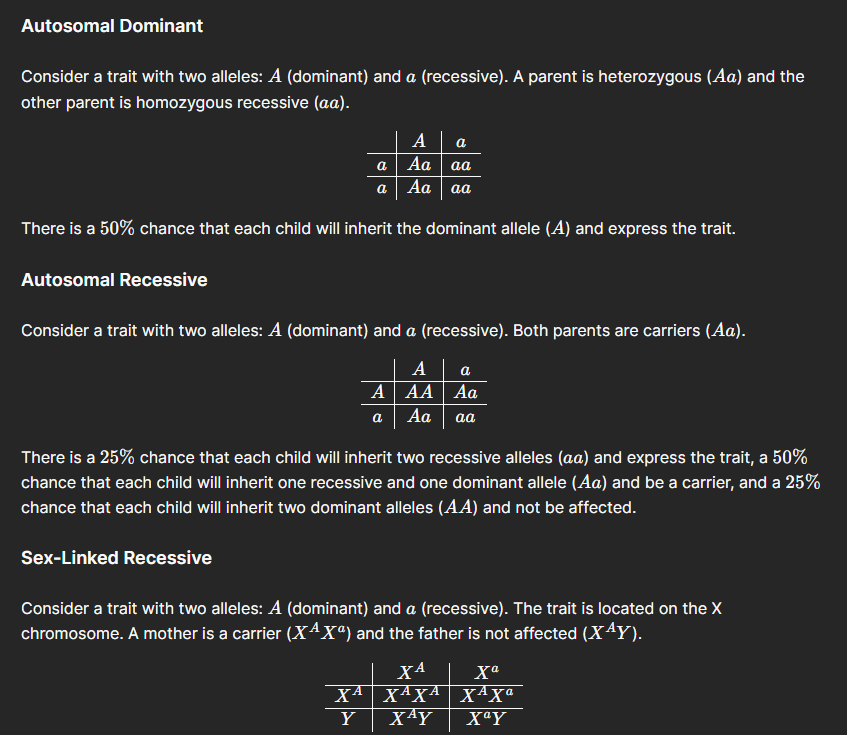
- Example Punnett Square (Carrier Parents - Aa x Aa):
A a +---+---+ A | AA| Aa| -> 25% AA (Unaffected, non-carrier) +---+---+ a | Aa| aa| -> 50% Aa (Unaffected, carrier) +---+---+ -> 25% aa (Affected) - Examples: Cystic Fibrosis, Sickle Cell Anemia, PKU.
B. Autosomal Dominant (AD)
- Genotype: Affected = AA or Aa; Unaffected = aa.
- Key Pedigree Clues:
- ❌ Usually does NOT skip generations. (Trait appears in every generation).
- ✅ Affected individuals MUST have at least one affected parent (unless a new mutation).
- ✅ Affects males and females roughly equally.
- ✅ Male-to-male transmission IS possible.
- ✅ Unaffected individuals (aa) cannot transmit the trait.
- Example Punnett Square (Heterozygous Affected x Unaffected - Aa x aa):
A a +---+---+ a | Aa| aa| -> 50% Aa (Affected) +---+---+ a | Aa| aa| -> 50% aa (Unaffected) +---+---+ - Examples: Huntington’s Disease, Achondroplasia.
- Why Cystic Fibrosis isn’t Dominant: CF requires two recessive alleles (aa). People with Aa are healthy carriers. Dominant traits show with only one dominant allele (Aa).
C. X-linked Recessive (XR)
- Genotype Notation: Xᴬ = dominant, Xª = recessive allele on X.
- Affected Male = XªY
- Affected Female = XªXª (rare)
- Carrier Female = XᴬXª
- Unaffected Male = XᴬY
- Unaffected Female = XᴬXᴬ
- Key Pedigree Clues:
- ✅ Affects males MUCH more often than females.
- ✅ Can skip generations (passed via carrier females).
- ❌ NO male-to-male transmission (Fathers pass Y to sons).
- ✅ An affected father (XªY) passes the allele to ALL daughters (making them at least carriers) and NO sons.
- ✅ Affected mothers (XªXª) have ALL affected sons.
- Example Punnett Square (Carrier Mother x Unaffected Father - XᴬXª x XᴬY):
Xᴬ Xª +-----+-----+ Xᴬ| XᴬXᴬ| XᴬXª| -> Daughters: 50% Unaffected (XᴬXᴬ), 50% Carrier (XᴬXª) +-----+-----+ Y | XᴬY | XªY | -> Sons: 50% Unaffected (XᴬY), 50% Affected (XªY) +-----+-----+ - Examples: Hemophilia, Red-Green Color Blindness.
D. X-linked Dominant (XD) Less common
- Genotype Notation: Xᴬ= dominant/affected allele on X.
- Affected Male = XᴬY
- Affected Female = XᴬXᴬ or XᴬXª
- Unaffected Male = XªY
- Unaffected Female = XªXª
- Key Pedigree Clues:
- ❌ Usually does NOT skip generations.
- ✅ Affects both sexes, often females more frequently.
- ❌ NO male-to-male transmission.
- ✅ Affected father (XᴬY) transmits the trait to ALL daughters and NO sons. (THE MOST IMPORTANT CLUE FOR XD).
- ✅ Affected heterozygous mother (XᴬXª) transmits to 50% of daughters AND 50% of sons.
- Example Punnett Square (Affected Father x Unaffected Mother - XᴬY x XªXª):
Xᴬ Y +-----+-----+ Xª| XᴬXª| XªY | -> Daughters: 100% Affected (Carrier XᴬXª) +-----+-----+ Xª| XᴬXª| XªY | -> Sons: 100% Unaffected (XªY) +-----+-----+ - Examples: Hypophosphatemic Rickets.
IV. Strategy for Analyzing a Pedigree:
- Dominant or Recessive?
- Look for affected individuals having at least one affected parent (suggests DOMINANT).
- Look for unaffected parents having affected offspring (confirms RECESSIVE).
- Does it skip generations? (Suggests RECESSIVE).
- Autosomal or X-linked?
- Are males and females affected about equally? (Suggests AUTOSOMAL).
- Are significantly more males affected? (Suggests X-LINKED RECESSIVE).
- Is there NO male-to-male transmission? (Suggests X-LINKED).
- Crucial Check: If you suspect XD, check if ALL daughters of affected fathers are affected. If yes, strong evidence for XD. If NO, rule out XD.
- Test Your Hypothesis: Assign genotypes based on your suspected pattern. Start with individuals whose genotypes you know (e.g., aa if recessive; aa if dominant & unaffected; XªY males if XR). Check for consistency.
V. Quick Summary Table (Integrates Punnett Logic)
| Feature | Autosomal Recessive (AR) | Autosomal Dominant (AD) | X-linked Recessive (XR) | X-linked Dominant (XD) |
|---|---|---|---|---|
| Skips Generations? | Often | Rarely | Often | Rarely |
| Unaffected Parents -> Affected Child? | YES | No | Yes (if Mother carrier) | No |
| Sex Bias? | No | No | Males >> Females | Females ≥ Males |
| Male-to-Male Transmission? | Yes | Yes | NO | NO |
| Affected Father has: | Depends on Mother | 50% affected kids (if Aa) | All daughters carriers, NO sons affected | ALL daughters affected, NO sons affected |
| Carrier Mother (het) has: | 25% affected kids (w/ Aa dad) | N/A | 50% affected sons | 50% affected sons & daughters |
VI. Final Tips for the Validation Test
- Practice: Work through example pedigrees.
- Process of Elimination: Rule out impossible patterns.
- Focus on the Definites: Unaffected parents having affected kids = RECESSIVE. Affected father -> ALL daughters affected = X-LINKED DOMINANT. No male-to-male transmission = X-LINKED.
- Read Carefully: Note shaded symbols, generations, relationships.
- Trust the Patterns: Stick with clear evidence unless contradicted.